| |
The name
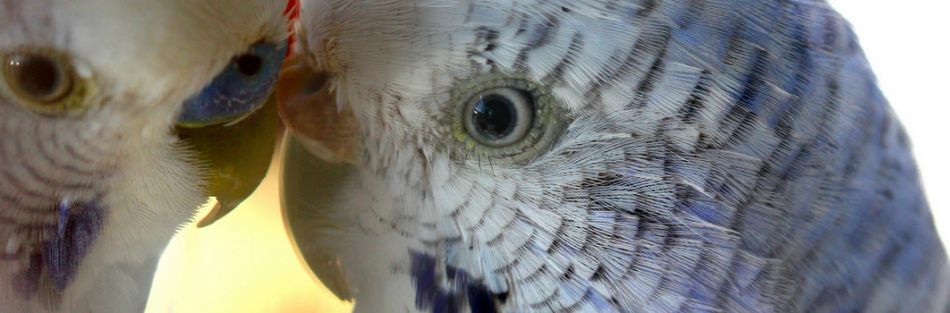
lovebird describes the persona this species portrays
to anyone observing the appearance and social behavior of
this small parrot. Their closeness to each other and their
constant preening shows how they acquired the name lovebird.
They are small, colorful, pocket size birds originating from
Africa and the island of Madagascar. They measure only five
to six inches in length.
All lovebirds
belong to the genus Agapornis. In the wild the lovebird's
natural color is green, but in captivity the lovebird is bred
in a wide array of mutated colors. Lutinos, yellows, whites,
blues, cinnamons, reds, pieds, and various combinations of
these colors display some of the most vivid and beautiful
feather colorations. Color mutations in lovebirds are extremely
attractive and are prized by many. You can expect to pay a
much higher price for a beautiful mutated lovebird than you
would for a common or normal-colored bird. However, the coloration
of the lovebird in no way affects the quality of the pet.
Profiles of Popular Lovebirds
There are actually nine different recognized species of lovebirds,
all with their own personalities. The peach-faced lovebird,
Agapornis roseicollis, probably the most common and
most available lovebird, makes an excellent first-time bird.
They have beautiful peach-colored faces with light green wings
and bodies. The flight feathers are black, and the upper tail
coverts and rump area are cobalt blue. The beak is a horn
color. Male and female lovebirds look identical. The peach-face
is probably the most aggressive of the lovebird species and
is generally not a good bird to house with other bird species.
They can be very territorial, especially a bonded pair. A
single bird will make an excellent pet for the bird hobbyist
and tames easily when acquired as a hand-fed baby.
The Fischer's
lovebird, Agapornis fischeri, is another common species
easily obtainable in pet shops or from private breeders. This
lovebird has the characteristic white eye ring around the
brown eye. It is a slightly smaller bird than the peach-face
and has an orange head and chest, green body, wings, and back
of head, and a blue rump. They have been bred in colors of
blue, yellow-green, white, and various pied shades. These
birds, too, are not sexually dimorphic. They are a bird full
of energy and easily handled by the first-time bird owner.
As with all lovebirds, their call is a shrill shrieking sound.
The masked
lovebird, Agaporis personata, is another readily available
and quite common species of lovebird. The bird is approximately
5 to 5 1/2 inches in length. Like the Fischers, they possess
a pronounced white eye ring. The normal head coloration is
black, and the body, green with yellow feathers on the chest
area. The natural color of the beak is red. Beautiful mutations
of this bird include green-blue bodies, yellows, pieds, cobalt
blues, and whites. The more unusual the color, the more expensive
the bird will be. This bird is commonly called a black-masked
or blue-masked lovebird. They are an aggressive species, a
little more high strung and do not tame easily. However, a
hand-fed baby bird can make an excellent pet. They are robust
and easy to care for.
Selection
Lovebirds
are known to live as many as fifteen to twenty years. As pets,
they adapt easily to living in apartments or houses. Being
a small parrot, they take up a relatively small amount of
space and their daily care is minimal. Their small size makes
them much less destructive than cockatoos or macaws and certainly
less intimidating. Large birds can be extremely loud at times.
The lovebird's call may be a bit more shrill, but the volume
is nowhere near as great. Their personalities and antics are
amusing and fun. They are considered curious, intelligent,
and comical. Lovebirds are not talking parrots, but their
expressive personalities and affectionate behavior toward
their owners make up for their lack of ability to speak.
Lovebirds
often appear to be happier when kept in pairs. As ornamental
birds in an aviary or large cage setup, this is true. But
if you want your bird as a companion pet, I would recommend
acquiring only one bird. Your lovebird will look to you for
the companionship and attention that it needs. If another
bird is in the picture, you will definitely take second place.
Lovebirds
can be somewhat difficult to tame and train when acquired
as older birds. However, hand-fed baby birds are ideal, as
they are accustomed to human touch and behavior. Select the
species and color you want from the breeder or pet shop and
be sure to ask questions about diet and basic care recommendations.
There is never too much information you can acquire when caring
for a baby exotic bird.
Care
Lovebirds
can be comfortable housed in a small cage as long as there
is room enough to allow the bird to climb the sides as well
as the top. The door should be large enough to allow you to
easily retrieve the bird on your hand. Generally, this will
be a cockatiel size cage measuring 20 inches wide by 20-to30
inches high by 20-to 36 inches long. These measurements are
only guidelines. Select a cage as large as your budget and
space will allow. Other features to keep in mind for your
bird's home are ease in cleaning, perch size, and adequate
space for toys. Lovebirds are active birds and love to fly.
I typically replace the traditional round perches that come
with the cage. Wood branches such as manzanita, cholla cactus,
and tree branches, free from insecticides and herbicides,
make great additions to the bird cage and encourage their
natural chewing behavior.
There
are several floor coverings available for bird cages. Corncob
litter, crushed walnut and newspaper are just a few. Talk
with your local pet shop about their recommendations.
Lovebirds
are very active and will enjoy a selection of toys. Hanging
toys of almost any kind, with multiple shapes and moving parts,
are great. Hoop swings, bells, rawhide leather, wood, and
most other chewable toys will be immensely enjoyed. During
play period outside of the cage, be sure the lovebird is always
supervised. It is a good idea to have your bird's wings trimmed
or learn how to do it yourself. Even though it is fun and
quite interesting to watch your bird fly, many birds fatally
injure themselves by flying into mirrors, windows, and walls.
Open toilets, windows, doors, kitchen sinks and stoves are
just a few of the many dangers in the average household. Trimmed
wings do not guarantee safely but lessen the odds of a disaster.
As with
any exotic pet bird, diet is extremely important. There are
several cockatiel/lovebird seed diets on the market. Not all
pet stores (or manufacturers) will label their food specifically
for lovebirds. A good cockatiel diet is what you are looking
for. When feeding seed, be sure to select a diet that has
vitamins added. This mixture will have necessary vitamins
and minerals added to the seed. In addition, there are several
pellet diets available that you should be feeding. I will
generally keep a pellet diet in front of my birds at all times
and offer seeds strictly as a treat. The advantage of pellet
foods is a complete nutritionally balanced diet. The disadvantage
is pellets are not natural in shape or in texture. Hooked
billed birds are experts when it comes to using their beaks
in climbing, preening, feeding, and cracking seeds. I feel
there is a psychological advantage to letting the bird use
its beak for what it is intended. You can still feed pellets
as a staple part of his diet, but supplement these meals with
nuts, seeds, fruits, vegetables, greens, cereals, and breads.
Most people foods will be good for your bird. As a general
rule of thumb, if it's good for you, it is probably good for
your bird. When in doubt, check with your veterinarian. As
a helpful hint, keep pellets in one dish and perishable items
in another. Variety in the lovebird's diet is the key to feather
perfect plumage and a healthy bird.
Breeding
Lovebirds
are easily bred in the home environment. They are capable
of breeding at less than one year of age, and a proven pair
will lay and incubate three to eight eggs. The eggs will hatch
in approximately 16 to 22 days depending on the species of
bird. The chicks will fledge in about four weeks.
Before
setting up a pair for breeding, you want to be sure you have
a healthy male and female. They should be in prime condition
and not in the middle of a molt. Their diet should be at its
best with additional vitamin and mineral supplements, leafy
greens, and protein. Lovebirds will nest in a standard-size
parakeet nesting box mounted to the outside of their cage.
The pair must be provided with a nesting material such as
newspaper which they will shred to build their nest. Both
parents will share in the task of feeding and raising the
young. If you are interested in hand-feeding the young, I
recommend you speak with an experienced bird breeder and learn
the technique before attempting to do it on your own. Baby
birds can be seriously harmed by poor hand-feeding technique.
Lovebirds
are wonderful little pets. They are curious and continually
investigate their surroundings. Hand-fed birds become very
tame and trusting. They are natural clowns and will lay on
their backs or climb into your pocket. Their robust and charming
personalities, along with their easy care and beautiful colors,
continue to make them a favorite among bird fanciers.
John Tyson is a freelance writer and photographer who lives
in Fort Wayne, Indiana.
|